Tuesday, April 25, 2017

Why are some states more war-prone?

Dinara Khalelova

Have you ever thought why some states are most prone to conflict? Some countries in the World are facing “infinite” number of conflict within the state and with other states. There is significant number of such countries. According to several sources, the worst bloodshed events are happening in Syria. BBC News (2017) states that Syrian Civil War is continuing from 2011, and took about 300 000 lives of people. Moreover, as a result of the war, approximately 11 million have lost their homes. Another country that is included to the list of the most war prone countries is Iraq. Iraq is also considered as the most dangerous war zones, because in the history of Iraq, there are a significantly big number of wars and conflicts took place. As in Syria, Iraq also undergoing a long war since 2014. UN reports that in 2016, according to calculations about 20 000 people were killed between 2014 and 2015.

Weeks (2014) in her book explains why some countries are prone to war. In order to find an answer, the author analyzes different nondemocratic regimes, including those of Saddam Hussein and Joseph Stalin; Argentine junta, and the communist regime of the North Vietnam. She believes that nondemocratic states have predisposition to war.  According to her findings, the type of authoritarian regime plays an important role in raising conflict.  She claims that in authoritarian state such as Iraq, where leaders of states directly and fully control the military, and more prone to start conflicts. However, authoritarian states that ruled by parties, like China, instead are less prone to conflict. It shows that not all authoritarian countries are war “lovers”.

To sum up, Weeks (2014) strongly believes that the regime type has a considerable impact on future prosperity of wars. She concluded that particularly countries with authoritarian regimes, like Iraq has the danger for having numerous conflicts.
_____________
References:
http://www.worldatlas.com/articles/the-world-s-most-war-torn-countries.html
http://www.bbc.com/news/world-middle-east-35806229
http://www.historyguy.com/wars_of_iraq.html#.WPomFvl97AU
http://www.globalsecurity.org/military/world/war/iraq-civil-war.htm


Weeks, Jessica L. P. 2014. Dictators at War and Peace. Ithaca; London: Cornell University Press

Monday, April 24, 2017

No Nukes!

Dauren Koptleuov

Recent Korean missiles launch as well as nuclear weapon testing escalated huge concerns in the international community. The United States responded with sending naval missile cruisers to the sea territories near Korean peninsula (Mirror, 2017). At the same time, Russia is witnessed to reinforce the border security with the North Korea, as the global unrest upsurges (Mirror, 2017). According to the Mirror (2017), Russia is taking precautious measures, because the consequences of US target attack on Korean nuclear storages may reach the territory of Russian Federation. While Russia is trying to alleviate the situation by calling sides for responsibility, the escalation of conflict may lead to unexpected and extremely destructive outcomes.

While the United States are not directly threatening, North Korea responds that US naval deployment is a severe “act of aggression” that certainly makes American side responsible in any “catastrophic consequences” that may take place as a result of conflict escalation (CNN, 2017). It is safe to assume that if the United States eventually decides to commit a missile stroke, North Korea will answer with all their nuclear might. Considering the personalities of leaders from both sides, who actually have an access to nuclear launch, the likelihood of nuclear conflict can only increase. As North Korean nuclear tests are considered as violating the international law (Reuters, 2016), the United States, as every rational member-state of international community, expectedly wants to make it stop. However, despite the visible difficulty of situation, there are some means of resolving other than preventive strikes or any other manifestation of violence.

As a political leader, Kim Jong Un is one of the most discussed ones in the modern days. He is known for extremely repressing behavior, fully totalitarian outlook, non-compliance with international norms and regulations and the haircut, of course. The United States are not likely to make diplomatic deals with such dictator, but Blair (2013) in his work about coup attempts does not propose to make deals with tyrants. The author advices the US military leaders to influence military leaders from authoritarian regimes so that they would raise the army against the despotic leader (Blair, 2013, Chapter 6). Of course, the example of Philippines by Blair (2013) does not resemble the North Korean one by several reasons. First, the military leader of North Korea is Kim Jong Un himself. Secondly, there is no protests that can escalate the armed conflict between civilians and ruling power. However, citizens would most probably hate (even if they do not openly demonstrate it) such leader that promotes the politics of oppression, constant violation of human rights and free will. Moreover, there are probably a decent amount of such people among the political and military elites, considering the barbaric repression methods of Jong Un. Therefore, the United States should certainly seek to try the method described by Blair, either with the help of its intelligence or entrism. Finally, there is a little possibility of elite rejecting the coup proposition on the threshold of mutually assured destruction.
_____________
Links and references:

Blair, Dennis C. 2013. Military Engagement: Influencing Armed Forces Worldwide to Support
Democratic Transitions. Washington, D.C: Brookings Institution Press.

http://www.mirror.co.uk/news/world-news/vladimir-putin-boosts-military-firepower-10259767

http://edition.cnn.com/2017/04/10/politics/us-aircraft-carrier-carl-vinson-north-korea-strike-capabilities/

http://www.reuters.com/article/us-northkorea-nuclear-russia-idUSKBN0UK14Y20160106


Dismissal of Generals and Increase of the Armed Forces Personnel in Russia

Azamat Kabdrash

There were two things on the news that grabbed my attention last month. The first – Putin signed a dismissal of 16 generals. The second – the Armed Forces are going to be increased by 19000 personnel by July this year.

If to consider the first case, in fact, we can observe almost regular dismissal of high ranking military officials over the last two years. Overall number of fired generals this year constitutes 20 people. 16 of them were fired on February and 4 – on January. They served in the Ministry of Emergency Situations, the Law Enforcement and in the Ministry of Internal Affairs (MIA) . Last year, Putin fired another 12 generals of the MIA.  The latter case was related to the reorganization of several departments of the MIA and their subordination to “Rossgvardia”, a body which was created on April 2016, by the Presidential decree. It now controls OMON, SOBR and other special military forces and is subordinated directly to the president. In addition, Putin dismissed entire fleet of naval commander last summer which counted about 50 people, including generals. The motifs for it were “incompetence and corruption” in the higher echelons of the Navy. In his interview to the Moscow Times, Dmitry Gorenburg, a Russian navy expert told “The Russian leadership is clearly fine with corruption … but if you do that to an extent that combat readiness suffers, there will be consequences.”  So these cases with the dismissals of high ranking officers show the readiness of the Russian system of Armed Forces to changes. The question is “are these changes improve the condition of Armed Forces, and particularly the Civil-Military Relations?” I will try to answer this question in the end.

This year Putin increases the military by 19000 people, 13698 of them will be active military servicemen, and 5357 will be civilian workers.  Experts suggest that there are two possible reasons for this. First, the situation in Syria; the second, development of legal and organization structure of Armed Forces . It is obvious that it is a part of military reform on the development and modernization of Russian Armed Forces. And I will give justification from our readings that Putin’s action that I have mentioned above will improve military condition in the country.

There are two arguments proposed by Desch which explains Russian case. When external threat is high and internal is low, Civil-Military Relations become healthier. As it was suggested in the news article, the situation in Syria, and increased risk of terrorist attack (my addition) might, in fact, lead to strengthening the organization aspects within the military. As almost one third of recruited military personnel is going to be civilian workers, I think that, it is another step toward increasing the objective control of the military. One of Shvetsova’s argument, mentioned by Desch, was that corruption within the military is one of the sources of decline in the professionalization.  The example of the dismissal of the personnel in the Navy is a practical justification that Putin would not tolerate such kind of corruption if it undermines the performance of the military.


Having revised the reading materials and the news I think that it would be just to conclude that Russia is in his way to improve both its conditions in the Armed Forces and the Civil-Military Relations in the country in general.

____________
  Novayagazeta.ru, “Путин снял с должностей 16 генералов МВД, СК и МЧС”, 2017, https://www.novayagazeta.ru/news/2017/02/02/128661-putin-snyal-s-dolzhnostey-16-generalov-mvd-sk-i-mchs
  Currenttime.tv, “Путин уволил 12 генералов полиции”, 2016, http://www.currenttime.tv/a/28037927.html
  Express.co.uk, “Putin fires ENTIRE fleet of naval commanders who refused to engage with West's battleships”, 2016, http://www.express.co.uk/news/world/688775/Vladimir-Putin-purges-entire-Baltic-fleet-officer-class-coverup-claims-submarine-collision,
  Rbth.com, “Why is Putin expanding Russia’s armed forces to 1.9 million?”, 2017,
http://rbth.com/defence/2017/03/30/why-is-putin-expanding-russias-armed-forces-to-19-million_730717
  ibid.


US Navy Criminalizes Nude photo Sharing

Zhandos Bolatbek

The distribution of photographs containing nudity without the subject’s permission will now be considered as a criminal offense in the US Navy and Marine Corps.

The new regulation has been enacted after a scandal erupted when a closed Facebook group, “Marines United”, with about 30,000 members, featured on its page photos with female servicewomen featured nude. About 27 people are thought to have been directly engaged in distribution of these photographic materials featuring nudity. Another group of about 29 Marines face administrative punishment. The Marine Corps, prompted by the scandal, now considers distribution of nude photographs as “cyber-bullying and discriminatory” and the offenders are subject to prosecution under Article 92 of Uniform Code of Military Justice with the possibility of up to 2 years of confinement.

There has been considerable outcry, with Marine Corps spokeswoman Capt. Ryan Alvis stating: “The Marine Corps is deeply concerned about allegations regarding the derogatory online comments and sharing of salacious photographs in a closed website… This behavior destroys morale, erodes trust, and degrades the individual.” Republican House Representative Adam Smith has called the instance as “degrading, dangerous, and completely unacceptable”. One concern has been that the language prohibiting the circulation of nude photos is legally sufficient since it is hard to prove that images were shared without consent or if the image was taken with consent but not was not intended for the sharing widely.

The distribution of nude photos by military officers evokes civilian problem of “revenge porn” whereby a person circulates nude photographs of his or her ex-partner and distributes them without the person’s consent.

Engaging in these kind of immoral activities by the army personnel would go counter to the Huntington’s idea of professional army. Such disregard and disrespect for the human dignity of fellow servicemen contributes to the erosion of discipline. The move by the Navy to criminalize the act of distributing nude photos without consent will contribute to the oversight of army professionalization.

___________
Reference:

1. Huntington, Samuel P. 1957. The Soldier and the State the Theory and Politics of Civil- Military Relations.

Is There A New Sharif in Town?

Dauren Koptleuov

In the beginning of 2017, ex-General of Pakistan, Raheel Sharif, was appointed as a first Commander-in-Chief (The Guardian, 2017), moving to Saudi Arabia in order to head the army of the Islamic Military Alliance (IMA) (Dawn, 2017). According to the Embassy of Saudi Arabia in the United States (2015), the purpose of this organization is to unite 39 Arabic, African and Middle East countries to fight terrorism and to counter the formation of such organizations as ISIS, Hezbollah, Boko Haram and others. Whereas the fact of creation of such anti-terroristic military organization that is already known as “Arabic NATO” is accepted with general optimism, Pakistani civil-military situation can possibly make government regret of “losing” such cadre as Sharif.

Pakistan is known as a state with military, which has a significant influence over the political matters of the country. According to Huffington Post (2016), Sharif was the first military leader who decided to cooperate with Pakistani government. Moreover, Sharif is popular because of successful elimination of terrorist threat in the region as well as criminal control of the Karachi, the biggest city of Pakistan (Huffington Post, 2016). That already demonstrates the weakness of government, as police is unable to control criminal activity even in the largest cities due to its either corruptness or incompetence. However, with the Sharif involvement in IMA activities and leaving the post of the General, eliminated threats may become relevant once again.

Historically, Pakistani government had literally neither objective nor subjective control over the military. The reason why the military has such amount of influence is most probably due to the continuous conflict with the India, where Pakistani military was the most important sphere in the state (Huffington Post, 2016). With the resignation of Sharif, already weakened civil-military situation in Pakistan will deteriorate unless there is another military leader that is willing to cooperate with the government. What is more possible to happen, is that dissatisfied military would overthrow weak civilian government and proclaim military rule. In case of Pakistan becoming a “junta”, as Weeks (2014) would put it, it is more likely to favor armed conflict rather than peaceful diplomatic resolution (Weeks, 2014), which may bring every more harm to the state and its citizens, considering unstable situation in the region.


___________
Links and references:

Weeks, Jessica L. P. 2014. Dictators at War and Peace. Ithaca; London: Cornell University Press

http://embassies.mofa.gov.sa/sites/usa/EN/PublicAffairs/Statements/Pages/Joint-Statement-on-the-Formation-of-the-Islamic-Military-Alliance.aspx

https://www.theguardian.com/world/2017/jan/08/former-pakistan-army-chief-raheel-sharif-lead-muslim-nato

https://www.dawn.com/news/1328349

http://www.huffingtonpost.com/raza-habib-raja/why-is-military-so-powerful_b_13269780.html

http://www.huffingtonpost.com/raza-habib-raja/pakistans-most-popular-ge_b_10954454.html


“Vinson” Carrier’s Missing: Trump-Pentagon’s miscommunication?

Aidana Sapuan

In response to growing tensions in the Korean Peninsula and increasing number of nuclear tests by the North Korea, President Trump made a drastic order to head “an armada” - the US Aircraft carrier group named “Vinson” from Singapore in the northern direction towards the abovementioned region. The vast majority of public has interpreted this move as an act of deterring North Korea and showing-off the US military capabilities, as Trump puts it: “Very powerful, we have submarines, very powerful, far more powerful than the aircraft carrier, that I can tell you” in an interview with Fox News Business .

The most shocking revelation came out when Trump’s decision was an act of bluffing, since official photos on the US Navy website indicated that the carrier was thousands of kilometers away in the southern direction from the Korean Peninsula2. US military officials made an announcement that “Vinson” will first complete the joint military exercise with the Australian military, thereby disproving the implementation of Trump’s official order to head the carriers in an opposite direction. A little later, Secretary of Defense James Mattis told that the joint exercises had been cancelled and from now on the carriers will be heading back to the North Korea.

All of these confusions in reports both by President Trump and  military officials (such as DoD, Pentagon, Mattis) raises thoughts about many important aspects of today’s civil military relations in the USA. The conventional wisdom of US civil military relations has at least two fundamental premises framed by the constitution: 1) the president is the commander in chief of the US Army, and by ordering special operations he is held accountable for them; 2) the president has to be aware of the state and locations of different items of the country’s military assets, and to be able to employ them in the times of need. In the context of these responsibilities put before the newly elected US President, wrongly announcing the deployment of the 97.000-ton carrier and its 60-plus aircraft against the country with unpredictable changes in its foreign policy like North Korea, to put it mildly, decreases the level of credibility and trust attributed to Trump by the public.

The other issue is grounded in the ambiguity around questions of “who?” and “why?” ordered “Vinson” to steam towards North Korea. Due to this confusion between different US military structures in their reports about Vinson’s whereabouts, it is very difficult to understand, which of these actors were involved in the command formulation process. From the point of civil-military relations, this might have a huge degrading effect for the US current state of CMR since it would mean that military is losing some of its advisory responsibilities before the state, which were strongly advocated by Huntington’s (1957) theory of objective control.

One of the possibilities is that the decision about “Vinson’s” deployment was made by Trump’s administration, which does not cause problems in legal terms, since such kind of operational decision-making under threat to US national security is the presidential prerogative. Nevertheless, following inconsistencies in reports do show the lack of inter-organizational coordination between the civilian leadership and Pentagon highlights the lack of expertise of the executive and makes the functioning of Trump as a chief commander of the US Army less effective.

___________
Reference list:
Huntington, Samuel P. 1957. The Soldier and the State the Theory and Politics of Civil- Military Relations. Cambridge: Belknap Press of Harvard University Press.

Web Sources:
http://edition.cnn.com/2017/04/19/asia/uss-carl-vinson-north-korea-timeline/
http://www.stltoday.com/news/opinion/columns/the-platform/editorial-in-a-nuclear-standoff-with-north-korea-trump-s/article_48f8c4aa-81f2-5494-916e-c27ef6c4a5a1.html

https://www.theguardian.com/world/2017/apr/18/us-military-shoot-down-north-korea-missile-tests

What should we know from Chinese Military Reforms

Bektas Baktybayev

China has the third strongest military and the largest military in terms of military manpower in the world. That is why it would be interesting to analyze the current reforms aimed to structurally reorganize Chinese military and their effects to civil-military relations. Starting in late 2015, China began to implement plans for structural military reorganization because of needs to increase Chinese military power. Those plans had been announced at the Third Plenum of the 18th Central Committee of the Chinese Communist Party (CCP) in November 2013, with the goal of fully implementing the reforms in military sector. One of these reforms were related to Civil-military relations. The topic of these reforms was in the following way: Enhance management of civilian-military integration.
Since the early 2000s, Chinese reformers have sought to achieve synergies by integrating the defense and commercial industrial bases more tightly. This would benefit the PLA, which would have greater access to civilian S&T advances, as well as the civilian economy, which would be able to incorporate dual-use technology initially developed for military purposes. However, it was difficult to achieve synergy due to the poor coordination between the military and civilian research communities.
The topic of the poorly developed civil-military integration (CMI) had became central theme of the Xi Jinping–era reforms which resulted in aforementioned structural military reorganization. The Third Plenum decision called for promoting joint military and civilian development, perfecting defense innovation systems, and promoting entrance of private civilian firms into the defense sector. In March 2016, Xi again called for “coordinated, balanced, and compatible” development of civilian and military resources, noting that this had previously been hindered by a lack of high-level coordination.

Professional Military Education (PME) is another important topic related to civil-military relations in Chinese military reforms. There was a need to introduce changes to PME in China due to the weaknesses in officer education and training. According to the Bruneau and Tollefson (2008) the ideal purpose of PME is to empower the military to implement policy and at the same time discourage military leaders from seeking to make policy. In democracies such as USA education is particularly vital as a conduit of a professional military ethos. The example of USA is important because Chinese military reforms in PLA (People’s Liberation Army) is moving toward a command structure more closely resembling the U.S. military.

The US military is known as a fully professional army. China is also going to professionalize its army. According to President Xi the plan will involve China transforming its Soviet-era military structures into a more professional US-style force, with integrated commands and a centralized headquarters, which can be seen from cutting of 300,000 personnel from its 2.3m-strong military force from the PLA. It means that China wants to establish objective civilian control. Huntington argues that objective civilian control is obtained through maximum professionalization of the officer corps.


To conclude, China is going to professionalize its military and to improve civil-military relations. China is following the US example of PME and professional army in order to achieve such aim.

___________
References:
Bruneau, Thomas C., and Scott D. Tollefson. 2008. Who Guards the Guardians and How: Democratic Civil-Military Relations. University of Texas Press.

Huntington, Samuel P. 1957. The Soldier and the State the Theory and Politics of Civil-Military Relations. Cambridge: Belknap Press of Harvard University Press.

Links:
http://indianexpress.com/article/explained/president-xis-military-reforms-in-china-increase-professionalism-in-the-forces-or-his-own-power/


Chinese Military Modernization

Zhandos Bolatbek

Toronto in his article “Why Professionalize? Economic Modernization and Military Professionalism” argues that states with higher human capital, urbanization, and economic wealth levels are more likely to professionalize.

Toronto states: “Now, more than ever, states and societies are concerned with the efficient use of military resources, and the information age has made the adverse consequences of military operations even more acute.”

Annie Kowalewski puts forward why the world’s most powerful military, the US, should learn about military modernization from Chinese army.
China has been the most prominent state in the world in terms of its rate of accruing economic wealth and the swift rise of its middle class. Along with the economic modernization it has also been modernizing its army.

As this age of information demands, China has been investing its efforts at enhancing its asymmetrical technological advantage. US Department of Defense reported that China is “developing its counter-space, offensive cyber operations, and electronic warfare capabilities meant to deny adversaries the advantages of modern, information technology-driven warfare.” For the Chinese Army priorities now include winning “informational local wars” and merge cyber- and space-related training into its military program.

Since December 2015, Chinese Army, People’s Liberation Army, has altered its structure of command. According to the Chinese military reforms, 7 Theatre Commands have been established according to their geographical proximity. Each of these Theatre Commands are obliged to oversee potential threats in their own regions and have to coordinate their efforts with other Theatre Commands. The shift from Soviet-style centralized command allows for more flexibility and coordination in the defense efforts.

However, there has been long held view that Chinese military is a “Paper Tiger”, that is, Chinese military looks strong and capable at the first glance, but only to that extent. Those viewing Chinese army as Paper Tiger underscore that compared to the US Army, which has had extensive and intensive experience of fighting in combat, Chinese army lacks just that. And that gives US an upper hand.

On the other hand, for the past decade and more, the US army has mostly been used to fighting and containing insurgency threats. As the author of the article argues: “The training necessary to combat insurgent groups with limited weaponry greatly differs from the training necessary to operate and utilize high-end technologies against a modern adversary. The Department of Defense’s entrenched bureaucracy also makes it difficult to adapt to new types of threats that require a quicker response time.”

__________

Reference: 
Toronto, Nathan W. “Why Professionalize? Economic Modernization and Military Professionalism”. Foreign Policy Analysis.

http://nationalinterest.org/blog/the-buzz/what-america-can-learn-chinas-peoples-liberation-army-20239?page=3

Sunday, April 23, 2017

Is there any problem with Military education in Kazakhstan?

Aigerim Suleimenova

The military education in Kazakhstan starts from the school when students are taught the basics of military equipment, this is called Basic military training. This is a required subject for all schools in Kazakhstan, however there are also special Military boarding schools in Almaty, Shymkent, Karaganda,”Zhasulan” military school for gifted boys, cadet corps named after Chokan Valikhanov where students live and military education, physical training, patriotism development, military –progess orientation are taught.

After school, there several higher education institutions Kazakhstan National Defense university, Military institute of air defense forces and so on where students get a higher military education and after a graduation can get an officer rank. Also there is ab obligatory military service for citizens from 18- 27 for one year. However now there is an existence of one month short military service which is accounted as a obligatory military service that was mentioned before, the payment for this is about 300.000 tenge.
From the first sight it can be seen that military education in Kazakhstan is developed, however the quality not quantity matters. Which kind and quality of military officers do it produce? As Karen Guttieri suggested (Bruneau and Tollefson)  education is a “central function of military organization”. Here it is important to highlight thay military education is not only about knowledge about military, equipment, training, specific skills but also is about values and behavior, morale and – obedience to authority. Also this is  supported by Huntington's characteristics of professional officer.  However as we can see from the examples like in Aktau the soldier was jailed because of the disobedience to higher rank officer because this soldier “ did not want to do the actions, because of many younger soldiers around, and he is an older time soldier” the military education of Kazakhstan gave not what is needed.

The need of a new military education was suggested by Bakytzhan Abdiraiym, the head of Military strategic research center. According to him there are three problems in military education lack of new equipment and military vehicles, second is inefficient management system and third is a quality of military education (!!!) This shows that there is a way of development of military education and we believe that this will be improved.
_____________
References
1. https://en.tengrinews.kz/military/Kazakhstan-needs-new-military-education-system-18068/
2. http://central.asia-news.com/en_GB/articles/cnmi_ca/features/2016/07/11/feature-01
3. https://www.mod.gov.kz/rus/obrazovanie/srednee_obrazovanie/?cid=0&rid=385
4. http://old.el.kz/m/articles/view/content-23637
5. https://www.mod.gov.kz/rus/obrazovanie/srednee_obrazovanie/?cid=0&rid=384
6. https://tengrinews.kz/kazakhstan_news/v-aktau-arestovali-soldata-za-otkaz-vyipolnyat-prikaz-314799/
7. Bruneau, Thomas C., and Scott D. Tollefson. 2008. Who Guards the Guardians and How:

Democratic Civil-Military Relations. University of Texas Press.

The Effects of Turkey's Referendum on Its CMR

Dauren Koptleuov

On April 17, Recep Taiyp Erdogan announced the victory for his campaign in the National referendum on significant constitutional changes in the Turkish Parliament. Success of the “Yes” campaign granted Erdogan considerable expansion of powers, turning Turkey’s parliamentary system into presidential (Al-Jazeera, 2017). Media reports tell about severe violations and fraudulence during the polls; prosecution of media; threats and various pressure on the supporters of “No” campaign; massive protests on the streets led by outraged crowd (Huffington Post, 2017). Apparently, Erdogan denies it all, and he certainly has his reasons.

After the attempt of coup d’état last summer, Erdogan strives to secure his position and increase the influence of his figure over the state by proposing constitutional changes. It is reported that the results of recent referendum will most probably be followed with more purges, imprisonments, adoption of the death penalty and development of a nuclear weapon (Huffington Post, 2017). In some way or another, the victory of the Erdogan’s campaign will have a significant effect on Turkish civil-military relations as well.

First of all, the results of constitutional referendum will abolish the functioning Turkish legislature with Binali Yildirim (Turkish prime-minister) in the head of it (The Washington Post, 2017). According to Giraldo (2008), the key function of legislature is to work as a check on the power and influence of executive on the defense sector, as well as maintaining “accountability, legitimacy and transparency” of the policy (Giraldo, 2008 as cited in Bruneau and Tollefson, 2008). In the current context of Turkey, the first function lost its purpose and the second one will presumably narrow down to “loyalty to ruling party” and to be promoted by the military police.

Speaking of the military police, Erdogan most probably wants to be aware of everything that happens within the Turkish military in order to avoid repeated coup attempt. This increases the likelihood that Erdogan can create special task force that would either implicitly or explicitly control the military from within. Considering that the percentage of “Yes” and “No” voters is quite levelled: 51.3% against 48.7%, Turkey is seemingly experiencing big division over political preferences. Apart from creation military police and regular purges, Erdogan is likely to enhance paramilitary forces that will secure his safety, even if the coup or insurgency would actually happen. Therefore, it can be said that Turkish military budget will probably also be the subject to change.

Finally, such increase in political powers of a single person may also affect the military doctrine of the state. Erdogan, as a political leader, fits perfectly the term “boss”, described by the Weeks (2014). She states that such authoritarian leaders, that have low possibility of being influenced by other political elites and high level of war-prone behavior, usually have higher possibility of war initiation as well (Weeks, 2014). Taking into consideration recent statements about stopping the fight with ISIS and plans of nuclear weapons (Huffington Post, 2017), it can be assumed that Turkey may start to pose threats to neighbor states as well international community, which may become the primary topic of interest very soon.

__________________
Links and references:

Bruneau, Thomas C., and Scott D. Tollefson. 2008. Who Guards the Guardians and How: Democratic Civil-Military Relations. University of Texas Press.

Weeks, Jessica L. P. 2014. Dictators at War and Peace. Ithaca; London: Cornell University Press.

http://www.aljazeera.com/news/2017/04/turkey-referendum-ak-party-claims-victory-170416162645193.html

http://www.huffingtonpost.com/entry/turkish-referendum-when-democracy-falls-short-of-a_us_58f23649e4b048372700d8a9

https://www.washingtonpost.com/news/worldviews/wp/2017/04/17/what-erdogans-narrow-referendum-victory-means-for-turkey/?utm_term=.cb0808f32636

Unchanging attitudes towards LGBT in Russian military

Zhandos Bolatbek

While the US is attempting to bridge the gap between civilians’ and military’s attitude towards members of LGBT community, Russia is staunchly trying to retain and conserve the old attitudes of its military toward members of the LGBT community. As Huffington Post reports, central administration in Defense Ministry of the Russian Federation “has developed a technical guide” featuring “physical examination”. This physical examination will include checking for tattoos in especially sensitive areas, such as sexual organs, buttocks and areas near the face. The justification for these kind of examinations seem to be stemming from the assumption that tattoos are a proxy for low level of cultural and educational levels, according to the guide. St. Petersburg Times stated that the presence of tattoos in these sensitive parts of the body may reveal “sexual deviations”. The guide also states that in the case when the influence is found to be external, it would demonstrate recruit’s “malleability” and “disposition to submit to another’s will”. The move by the Russian Defense Ministry seems to reflect the wider Russian agenda to suppress any LGBT movement, with the major legislation on anti-gay propaganda already in place. Whether the new guide will contribute to the anti-LGBT agenda is highly doubtful, since it is very difficult to discern “sexual deviations” from tattoos in recruits’ sensitive parts of their bodies.

These measures show how the Russian government is averse to give way for more tolerance of LGBT recruits in the army which stands in sharp contrast with the US military. As Feaver and Kohn found out there was a considerable gap between civilian population and the military where the former was much more tolerant towards LGBT serving in the military and the latter was somewhat disapproving. There was also “Don’t ask, don’t tell Act” which required that the recruits and officers kept their sexual orientation secret. However, since the publication of Feaver and Kohn’s findings “Don’t ask, don’t tell Act” was repealed and gave the right of LGBT recruits to openly disclose their sexual orientation. This indicates how Russian and American attitudes diverge in terms of views on LGBT people in the military. Although there seems to be strong intolerance towards LGBT people in the Russian army, UN’s 2007 report indicates that homosexuality and male prostitution is “quite common within Russia’s military”. It seems that attitudes towards LGBT people in the military will not change in the near time, since Kremlin is pushing for it and has the support of influential Russian Orthodox Church.

_________
Reference:
Feaver, Peter, and Richard H. Kohn, ed. 2001. Soldiers and Civilians: The Civil-Military 
Gap and American National Security. MIT Press. 


http://www.huffingtonpost.com/2013/01/24/russia-gay-tattoo-check-soldiers-military-laws_n_2545637.html

Japan seeks to Reduce Civilian Control of the Ministry of Defense

Dinara Khalelova

Officials of Japan’s Ministry of Defense was planning to propose to the Diet corrections for the decision making structure of the Ministry of Defense. Their main aim was to make Self-Defense Force officers on equal footing with their civilian bureaucratic counterparts. This amendment gives civilians greater control over Self Defense Force (SDF). According to the Japan Times (2015), initiative was given from SDF personnel as well as former members who are now Diet lawmakers.
Simply, by this reform the chiefs of staff of the SDF branches will support the minister as equals to the director-general of ministry bureaus and the director-general of the Minister’s Secretariat. Also, SDF units assigned to respond to a contingency will be able to report directly to the minister and the minister can instruct SDF units directly through the chief of staff of each SDF branch (The Japan Times, 2015).

There are two types of control, according to Huntington (1957). First one is subjective civilian control, where professionalism of military is maximized, and decreases the control of civilians. Second type of civilian control is subjective, it is instead maximizes power of civilians by governmental institutions, social class, and constitutional form. However, Huntington prefers objective control over subjective. Because, as it was said above, objective civilian control maximizes military professionalism.

This shows that Japan`s Ministry of Defense is trying to reinforce the power of the subjective civilian control. Despite the fact that the objective civilian control is more beneficial for the state military. Japan`s amendment allows to uniformed officers to directly participate in works of the ministry.

______________
http://www.japantimes.co.jp/news/2015/02/22/national/defense-ministry-seeks-to-reduce-civilian-control/#.WPnui_l97AU

Huntington, Samuel P. 1957. The Soldier and the State the Theory and Politics of Civil Military Relations. Cambridge: Belknap Press of Harvard University Press.

Military Education in Kazakhstan

Daniyar Tengelbay


In March 2013 president of the Military-Strategic Research Center Bakytzhan Abdiraiym pointed that one of the main problems of Kazakhstan’s army is military education. He suggested to reconsider the whole system of military education and argued that Kazakhstan need highly intellectual officers, which study not only in military academies but also in top universities of the world. There was also stress on emotional factor as there is need in psychological fitness and stress resistance.

Since this time, Kazakhstan agreed with several states to cooperate in military education as part of bilateral cooperation. For example, agreement with China in 2015 regarding free technical assistance for Kazakhstan’s army and cooperating in military education. (Part of Kazakhstan’s military personnel is educated in Chinese military academies) Moreover, from fall 2016 Kazakhstan’s military academies introduced new disciplines as military ethics, military logistics, military radio electronics and engineering, military management and military jurisprudence. This is also a part of development of state’s military education.

In addition, Astana Times informs that US and Kazakhstan developed a project for 2016-2017 military cooperation. It is directed to improve professionalism of military and developing the military education. As US interested in regional security of Central Asia it will assist Kazakhstan’s military academies with teaching methods and considers cadets exchange.
 
According to Bruneau and Tollefson (2006), military education should inculcate loyalty to civilians and directed to avoid coups and other interference in states politics. It should develop professional behavior and teach respect and obedience to higher administration.


Kazakhstan is in right way of developing its military education as it cooperates with states that have strong militaries. It already had been improved much as young men willing to be in Armed forces are more than the army needs. This is mostly because military is in process of professionalization and military capacities are improved by time.

____________
http://astanatimes.com/2016/03/1-4/ 

https://en.tengrinews.kz/politics_sub/China-continues-strengthening-military-relations-with-262536/ 

https://en.tengrinews.kz/military/Kazakhstan-needs-new-military-education-system-18068/ 

http://bnews.kz/ru/redesign/news/kak_popast_v_elitnie_voiska_kazahstana

Bombing Syria: The US Needs to Adopt a New Authorization for the Use of Military Force

Aidana Sapuan

In response to Assad regime’s use of chemical weapons against nonviolent Syrian citizens, on April 7, 2017 newly elected President Trump authorized 59 Tomahawk missile strikes. This has raised serious doubts about the lawfulness of Trump’s unilateral decision both under the US Constitution and the international law.

The US Constitution in Article I clearly states that the decision and responsibility to start a war belongs to Congress, not the president. Though the president can make a sole decision to repel sudden attacks, Assad’s recent actions in Syria do not represent such worries for the US national security.

Shortly after the 9/11 attacks, the Congress adopted the Authorization of the Use of Military Force (AUMF) to take violent actions against “those nations, organizations, or persons he (the president) determines planned, authorized, committed or aided the terrorist attacks that occurred on September 11, 2001, or harbored such organizations or persons.”  This document has given a president of the US a mandate to make a unilateral decision to use force against a particular type of actors connected to a disastrous event in 2001. Nevertheless, during the following 16 years presidents have been using this resolution to justify operations in the Philippines, Yemen, Somalia and Syria, sometimes with a minimal connection to the main cause stated in AUMF.

In the context of this document, ISIS and Assad’s regime do not seem to fit the characteristics that would allow the sole decision to use force, since the former is an organization that did not exist in the time of 9/11 attacks, whereas Assad regime’s direct threat to US’s national security is under a big question. Therefore, the question of whether Trump’s decision violates US constitution still remains open.

There was a precedent during Obama’s administration that reflects today’s concerns around Trump’s order to deploy missiles in Syria. In 2013, Obama unilaterally authorized striking against Syria after Assad’s use of chemical weapons. This has provoked a big discontent among the representatives in Congress, which ended up by an unsuccessful presidential request to redesign and adopt a new AUMF . This precedent might explain the inactivity of current members of Congress as a kind of tacit consent to comply with Trump’s sole decision to use military force against Syria.


Nonetheless, though there might be a silent consensus between Congress and President Trump about the morals and motives for the use of US military force in Syria, do things have to stay the way they are? In terms of sustaining healthy civil-military relations, the answer is definitely no. The adoption of a new separate AUMF for Syrian conflict would define the scope of the mission and outline political and military objectives of potential military operations in Syria. Moreover, the Congress is in urgent need of providing the channel for public to check if the financial, human and military capability costs associated with the “war” is worthwhile for the Americans. President Trump’s unilateral decision to employ bombing attack in Syria and the following public debate over new AUMF is a real-world example of the theory by Avant explained in Bruneau and Tollefson (2008). Her theory, the division of civilian power between the executive and the legislature might potentially degrade the wellness of civil-military relations in the US, since instead of forming a bilateral decision, parties will try to “play one off against the other” and to promote its own interests (ibid, 61).

__________
Reference list:
Bruneau, Thomas C., and Scott D. Tollefson. 2008. Who Guards the Guardians and How: Democratic Civil-Military Relations. University of Texas Press

Web sources: 
https://www.justsecurity.org/39695/illegal-hard-part-begins/
http://www.cbsnews.com/news/trumps-challenges-in-asking-congress-for-authorization-for-use-of-military-force/
http://www.rollcall.com/news/politics/military-force-syria-congress
http://www.concordmonitor.com/Congress-must-act-on-new-Authorization-for-the-Use-of-Military-Force-9250103


Trump’s Decisions about the Military

Kamila Shurmanova

President Donuld Trump has made some debatable decisions, for which he faced a lot of criticism. He has filled main posts in the Cabinet with recently retired generals, with an aim to shape national security policies of the US, another issue is that Trump has not appointed some major civilian posts that are responsible for watch over military personnel and their decision. Recent US attack of Afghanistan has triggered new debates, authorities are not happy about the freedom Trump has granted to Defense cabinet that lacks civilian control.

"What I do is, I authorize my military,” he said. “We have the greatest military in the world, and they’ve done a job as usual. So we have given them total authorization, and that’s what they’re doing. And, frankly, that’s why they’ve been so successful lately."

“The commander-in-chief and the people immediately around him are somewhat malleable when it comes to national security," Smith said, pointing to Trump’s about-face last week in ordering a strike on the Syrian military for its use of chemical weapons. “You can’t imagine anyone more opposed to military action in Syria than President Trump right up until he ordered the strikes. I’m worried President Trump is going to go with such a military-heavy set of advisers."

A lot of people are worried about the autonomy military has faced recently and the amount of trust Trump entitles them with. Syria appears to be the most vivid example of the autonomy military has recently gained. U.S. troops are currently helping their local allies in Syria to get ready to an offensive attack of ISIS’s headquarter that is located in Raqqa.


Trump’s decision imply to the subjective/objective control theory proposed by Huntington (1957). Objective civilian control militarizes military and makes them a tool in the hands of the government. Even though Huntington (1957) claims that  generally objective control is a better approach to professionalize military, he emphasizes the importance of balance between civilians and military. Trump, on the other hand, has granted a complete authority to military by putting on the commander positions recently retired officers (which is against the law of 7 years gap between military and civilian administration service) and by failing to fill the posts that supervise military policies.

________
http://www.politico.com/story/2017/04/trump-military-strikes-generals-237214 

Interesting Facts about Coups

Dinara Khalelova


Recently on July 2016, in Turkey was one of the bloodiest coup attempts. Turkey`s armed forces tried to overthrow the President Erdogan. However, thousands of citizens gathered together and were protecting their leader. Before, Turkey has faced two more military coups, but it was the first time, when citizens were involved in standing against of the coup.  As a result, this coup in Turkey has failed.  So, that coup was special one in the history of Turkey. This short blog will cover several interesting facts about coups, particularly about Turkey and Mali coups.

First of all, it is important to start from looking at the results of coups. It is interesting that sometimes coups reach successful endings. According to Thyne and Powell (2016), approximately the half coup attempts have failed, what means that another half of coups ended successfully. Moreover, authors have calculated the number of coups that led countries to democratization, it is 6 percent from all coups, and the number of coups that led to a dictatorship is 3 percent.

Another interesting thing happened during the coup in Turkey was the increase of requests in Google search with questions “How to stop a tank?” As it was said before, simple people gathered together on streets, and were fighting against the military of Turkey in order to defend their president. For this reason, in YouTube appeared videos with instructions for defeating tanks.  In addition to this, opponents of Gulen in order to show their disappointment were trying to humiliate him by firing and destroying all books written by him, and made public toilet from his home, where he grew up.

According to List 25 (2017), one of the most violent coups after 2000 was Malian coup in 2012. The New York Times (2012) claims that Senegal soldiers wanted to overthrow current President Amadou Toumani Touré, and attacked the capital Bamako. As a result, number of victims was a huge, about 15 000 soldiers were killed, but despite this fact the coup has ended successfully. One more interesting thing was posted by The Washington Post that the leader of the coup, Captain Amadou Haya Sanogo several times has trained in the United States.

___________
http://beyazgazete.com/haber/2016/7/23/gulen-in-dogdugu-ev-umumi-tuvalet-oluyor-3393022.html
http://www.hurriyetdailynews.com/10-amazing-facts-about-turkeys-failed-coup-attempt.aspx?pageID=238&nID=102122&NewsCatID=550
Thyne, Clayton L., and Jonathan M. Powell. 2016. “Coup D’´etat or Coup d’Autocracy? How Coups Impact Democratization, 1950–2008.” Foreign Policy Analysis 12(2): 192–213.
http://www.nytimes.com/2012/03/23/world/africa/mali-coup-france-calls-for-elections.html
https://www.washingtonpost.com/world/national-security/leader-of-mali-military-coup-trained-in-us/2012/03/23/gIQAS7Q6WS_story.html?utm_term=.6780080b4f55

Was the Coup in Burkina Faso in 2015 Successful?

Aigerim Suleimenova

Burkina Faso is a former French colony and became independent in 1960. This is a semi presidential government, and from 2000 the presidential term is 5 years. The whole history of independent Burkina Faso is correlated with its first president Blaise Compaore who overthrow his friend –Thomas Sankara with a French help and seized a power in coup d’état until 2014 when he was displaced by mass protests. This was a response to the changes in Constitution that could allow presidency of a Compaore.

The mass protests were successful therefore Blaise  dissolved parliament and resigned and gone. However what is interesting is that the several month after this, on September 2015 just before new president elections,  the members of  Compaore presidential guard (Regiment of Presidential Security, RPS) which is basically a branch of Burkina Faso’s military in a charge of protecting the president. There were 1200 men with big amount of weapons who were loyal to RPS, which claimed itself an autonomous military unit. The reason of the coup was worry of soldiers that new president will make the end of RSP, because there was no need “army in army”.

This coup was successful and the capital –Ouagadougou was seized and they proclaimed about the establishment of the junta ( military junta- military dictatorship) headed by General Gilbert Diendere. Despite this fact, there was no support from regional leaders and the regular army ( branch of Burkina Faso’s military)  entered the capital and this was the end of the coup. The duration of coup was about 7 days, 11 people died and about 250 people were injured. Despite the fact that this duration was 7 days and this applied as a successful coup, this coup has failed. According to Bertrand, the researcher from Warwick university the major factor was that this coup was unpopular and the RPS did not control the army of the country, second is regular army has an effective tactics in preventing coup, they were highly specialized.

Also as Talmadge (2015) suggests that the success of failure depends on effectiveness of military of the state, its organizational practices, right battlefield power and so on. Also this is important not only when the external threat comes, but such military is important because of “an active liability for regimes vulnerable to military coups”. The Burkina Faso is an example, where military coups existed from the time of its independence. The author gave four key features of military actions that help to prevent coups. These are promotion patterns (military’s human capital), training regimes, command arrangements, information management. Here we can see that promotion patterns and command arrangements did not help to prevent, rather catalyze the coup as  RPS was afraid of new constitution changes that can end its power therefore they did a coup.

__________
1. Ouedraogo, Brahima (2015). "Military detains Burkina Faso's president, prime minister weeks ahead of landmark vote". U.S. News & World Report. Associated Press. 
2. http://www.aljazeera.com/news/2016/10/burkina-faso-coup-attempt-thwarted-government-161021154201818.html
3. http://www.economist.com/news/middle-east-and-africa/21670491-power-shifting-military-civilians-burkina-faso-why-burkina-fasos-coup-failed
4. Boukari Ouoba. "A triumpf for young people
5. https://www.theguardian.com/world/2015/sep/24/burkina-faso-coup-rise-and-fall-of-what-you-need-to-know
6. http://www.economist.com/news/middle-east-and-africa/21670491-power-shifting-military-civilians-burkina-faso-why-burkina-fasos-coup-failed
7. https://www.theguardian.com/world/2015/sep/25/burkina-faso-foiled-military-coup
8. Talmadge, Caitlin. 2015. The Dictators Army: Battlefield Effectiveness in Authoritarian
Regimes. Ithaca; London: Cornell University Press.

Generals in the Government: Problems with Overriding the Law.

Kamila Shurmanova

Jim Mattis, appointed by President Trump as Defense Secretary, is a newly (3 years out of active service) retired officer. He recently proposed that the use of military force against ISIS should be legalized. His main claim is that the terrorist has already erased the limits of time and geographic issues by their acts. Mattis argues that the idea of military response to the ISIS has been in his head for several years now and that he is very surprised that it has not been even brought to debate yet.   Joint Chiefs Chairman Gen. Joe Dunford has supported Mattis’ ideas and they both argued that more budget should be given to the Defense, so they can ‘reclaim military readiness’. Defense Secretary also pointed out that law has made US military more damage than on field battles with enemy.

"I can find nothing in the Budget Control Act that helps our national security," Mattis testified, adding that the law places Congress in a "spectator role."


Mattis’ proposed actions are very militaristic and focused on the aggression towards an enemy. He proposes to stop endless discussion and start acting, these judgments might come from the fact that Mattis has not fully re-entered civilian life and is still thinking as a military officer rather than a civilian authority. In the US there is a law that a military officer might start political service only 7 years after his retirement, so he can have time to get out of the military judgment. Pr. Trump has closed his eyes on this law when he appointed Jim Mattis to the position of Defense Secretary, despite all the doubts that other authorities had. Judging from the propositions that Mattis gives it is evident that he is still biased and his  ideas are limited by his military habits.

____________

Is China’s Slowdown in Military Spending Real?

Aidana Sapuan

On March 5, 2017 China’s Ministry of Finance made a surprising report, announcing that this year’s military spending increase will be only about 7% (compared to 7.6% in 2016), the slowest pace since 20101. Being the second largest army in the world after the US and given potential disputes with the US over the South China Sea and Taiwan, this announcement might convey an important message to its territorial neighbors as well as to its biggest military rival – the US under Trump’s administration.  Nevertheless, China’s more assertive foreign policy and its involvement in arms race with the US attribute a great controversy to this year’s military cutback.
The announcement is even more unaccustomed to Chinese presidential governmental reports, since for the first time in decades the exact figure for total military budget of 2017 was not revealed. This has raised concerns in the international community about the absence of transparency in China’s decision-making apparatus. But more importantly, the decrease in the growth rate of military spending can potentially degrade internal civil-military relations of a country. Under the initiative of President Xi Jinping, about 300.000 troops are going to be cut by the end of 2017, which has spoiled in February’s 2-days demonstration by the PLA (People’s Liberation Army) veterans demanding retirement benefits for demobilized personnel.
In the light of continuing tensions with the US, internal difficulties in managing the military and the ongoing military reformation, reporting on decrease in the growth rate of military spending raises a logical question: “Does China really intend to slowdown its military growth?” There are at least two reasons to think that “no” is the more appropriate answer for this question.
Firstly, Center for Strategic and International Studies estimated a large inconsistency between estimates from China’s official reports on military budget and the outside estimates by the Stockholm International Peace Research Institute (SIPRI). Comparatively, though China officially reported to spend $144.2 billion in 2015, the outside estimate equaled $214.5 billion. China’s lack of transparency and weak commitment before the international community to provide detailed reports is one of the explanations to this discrepancy. Moreover, there are other sources financing different items of China’s military on a regular basis, as said by Collin Koh Swee Lean, an associate research fellow at S. Rajaratnam School of International Studies in Singapore: “One shouldn’t really trust those figures, because Beijing could have hidden budget overlays for such opaque activities as military R&D, or other expenses beyond what it wants the public and the international community to know about.” Indeed, there are other sources of income that come from PLA commercial enterprises, militia off-budget income, etc which is mainly spent on procurement of military equipment from Russia.
Second reason is grounded on Xi Jinping’s latest initiative to head a new central commission for integrated military and civilian development. In the context of the latest budgetary changes, the role of this commission might be to mobilize civilian resources to flow into the military sphere. As such, companies in China are required to make budget contributions into ‘civil-military integration’ schemes to finance infrastructure, R&D, PLA capabilities under legal off-military budget framework.
China’s cutback in the growth of military spending provides a good contextual framework for analyzing the importance of establishing consistent and consequential method for budget allocation of the military sphere. Absence of transparency of budget allocation schemes, opacity in splitting the budget across different military items and other issues are the reflection of the main problem faced by consolidating democracies as posed by Geralde (in Bruneau and Tollefson, 2008). Indeed, China’s cutback of military spending in absolute terms does not reflect real changes in how and where the money is spent. Whether it is caused by the inability of civilian government to control military budget decision-making process, by the closed process of budget formulation or by China’s attempt to convey a wrong message to the international community is still under a big question. Nevertheless, even a slight deviation of budget decision from what the real state of civil-military affairs needs might spoil serious problems for China in terms of relations between the military and the civilians.

_________________
Reference list:
Bruneau, Thomas C., and Scott D. Tollefson. 2008. Who Guards the Guardians and How: Democratic Civil-Military Relations. University of Texas Press

Web sources:
http://www.bbc.com/news/world-asia-china-39165080
http://www.aljazeera.com/news/2017/03/china-2017-military-budget-rise-slows-170304072324642.html
http://chinapower.csis.org/military-spending/
http://www.reuters.com/article/us-china-defence-idUSKBN15706


Females on US Navy Submarines

Kamila Shurmanova


Up until 2010 in the US there was a ban of women on Navy, however with this ban being listed more women are enlisted to serve on subs both as privates and officers. In order to make submarines for women to serve on, they are being redesigned so they would be more suitable for women on the board. These changes include adjusting seats, making them a little closer to the panel, lowering overhead valves, adding one more bathroom to the sub, installing steps to the triple-high bunk beds. The changes would make women’s presence in the sub more efficient, because they would feel more comfortable and would be able to perform as good as male soldiers. However, with the number of obvious pros come cons, Electric Boat officials did not make proper estimations on the issue of the costs of these changes, and also these adjustments might make male’s service less efficient. New readjusted Columbia-class ballistic-missile sub will join fleet in 2031, generally this sub will make the service of females and males that differ in height and weight from an average soldier.

Redesigning subs for the convenience of female soldiers is a sign of moving past the prejudices and discrimination and changing attitude towards women in the army.   Feaver and Kohn’s (2001) research shows that elite officers were opposed to females serving in army. Generally, the experiment shows that combatant women are more supportive of integrating more women to army forces, less civilian women voted for the reform, as for the men, civilian men are more supportive of the idea than combatant male. Feaver and Kohn (2001) emphasizes two finding on the topic: ‘elite military officers are more supportive of gender equality in the services than are mass civilians, up to, but not including women in combat’ and another finding is that male officers are less supportive of females in combat than mass civilians in general. The fact that military is trying to make the conditions more convenient for females, shows that the attitude is finally changing. 

_______

Increase in US Military Spending

Daniyar Tengelbay


Eshe Nelson in her article informs about Trump’s proposal to increase military spending by $54 billion next year. She compares proposed military spending with overall budgets of different states analyzing that this new spending would be higher than overall budgets of Israel, Canada, Taiwan, Turkey and Mexico combined. She also states that this will be race with Russian military spending which is approximately the same as proposed one.

In his turn, Bruce Gagnon, secretary and coordinator at the Global Network Against Weapons & Nuclear Power in Space, says that US is heading to rule the world increasing its military capacities. According to him, “The US is telling North Korea, Iran, Russia and China that you must surrender to our domination or we will destroy you.” US is dependent on military spending which could lead to the collapse of its economy.

According to Bruneau and Tollefson (2006), military spending is very important factor in civil-military relations. It is one of the factors on which directly dependent the civilian control over the military. Efficiency of the military control depends also on the amount of spending taking into account other spending beside the military as the outspending for defense sector could cause bankrupting the state and hurt its economy. However, the military spending is more likely to prevent the corruption and discipline loss in military, and provide more professionalized military. As Huntington stated civilian control over military leads to professional military.

In this case of increase of spending in defense sector US does not seem like there is lack of professionalism in their military and the issue could be Trump’s personal politics to provide himself military support. As it known, he already had some retired generals in his team. Thus one could suppose that he is politicizing military as he increases the spending and military would support him more. As the military spending would be more than some states’ overall budget both the world and locals will see the capacities of their country, this would provide local support and frighten the world. However, Trump is willing to rise military spending even there will be need for contraction in other sectors. Thus, this would work as far as it will not negatively affect overall US economy.

___________
http://www.presstv.ir/Detail/2017/04/17/518328/US-addicted-to-war-military-spending 
https://qz.com/937285/donald-trumps-proposed-54-billion-boost-to-defense-spending-is-bigger-than-the-total-annual-military-budget-of-all-but-two-countries/ 

What is an attitude towards homosexuals in military in US?

Aigerim Suleimenova

What is the attitude towards homosexuals in military in US?

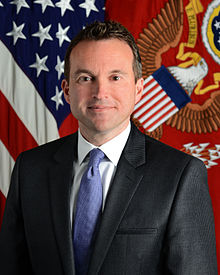
In November 2015, the former President Barack Obama has nominated a new Secretary of Army, and in May, 17 2016 the United States Senate has confirmed nomination. The 22nd Secretary of the Army became Eric Keneth Fanning, who had made a great career as a Congressional staffer, chief management officer for the Department of the Navy, Under secretary of the Air force spending about overall 25 years in government service. However America has a plenty professional military officers, why was this case interesting? The Eric Fanning was the first openly gay in Pentagon . However the situation in last decades was different and gay men and women were not allowed to show their sexual orientation.

The US military policy of 1981 stated ’ “homosexuality is incompatible with military service” is based on the premise that a gay military member’s presence “adversely affects the ability of the Military Services to maintain discipline, good order, and morale.” It was not possible to prohibit the involvement of gay people to the military at all, therefore, in 1994 the President Clinton has adopted the “DADT” policy. “Don’t ask don’t tell policy” stated that homosexual gay and woman are prohibited from serving in US military if they disclose they sexual orientation and only in 2010 the process of ending this “DADT” policy established, therefore from that time homosexual people can serve in military and show their sexuality.

According to study, the 43 % of Americans favored allowing gays to serve in military in 1993/94, however the number has increased dramatically to about 70 %, which means that public became more tolerate.  Also as Davis (chapter 2) showed in his national cross section of US adults (mass) and army officers (brass)   16 % of male officers are opposed to “allowing gays and lesbians openly serving and this lead to author’s “finding 6”.
 
Despite this, according to National Longitudinal study of Adolescent Health (2009) the number of men in military who identified themselves as a gay was approximately the same with those among civilians. This shows that despite the existence of the “DADT” policy the number of homosexuals in military does not decrease, it rather increases and now the representative of gay minority is a head of the largest military service in US. Also what is important Roman and Tarr (chapter 11) argue that when the senior military leaders are selected, the candidates are selected accordingly their “professional background, policy making, experience, personality and political consideration” and what is more important the characteristics that makes a candidate “effective” and here the sexual identity does not matters. Therefore when the question of sexual orientation in military arises, it is more important to look if the person is a professional and does he or she has expertise, responsibility and corporateness.

___________
References:
1. https://informburo.kz/novosti/suhoputnye-voyska-armii-ssha-vpervye-vozglavil-gey.html
2. http://www.rand.org/pubs/periodicals/rand-review/issues/2011/spring/gays.html
3. "H.R.2965 - Dont Ask, Dont Tell Repeal Act of 2010". OpenCongress.org
4. http://biotech.law.lsu.edu/blaw/dodd/corres/html2/d130426x.htm
5. Sexual Orientation and U.S. Military Personnel Policy: An Update of RAND’s 1993 Study, 2010.
6. Sexual Orientation and U.S. Military Personnel Policy: Options and Assessment, RAND Corporation, RAND/MR-323-OSD, 1993, 548 pp., ISBN 0-8330-1441-2.
7. Feaver, Peter, and Richard H. Kohn, ed. 2001. Soldiers and Civilians: The Civil-Military
Gap and American National Security. MIT Press.

8. http://www.military.com/daily-news/2017/01/18/fanning-steps-down-first-openly-gay-service-chief.html

Wednesday, April 19, 2017

Failed Coup in Turkey and the New Referendum

By: Azamat Kabdrash

Turkey has become an object of increased interest in recent times. One of widely discussed issues is the referendum which is held on April 16. It intended to make considerable changes to Turkish Constitution by changing governmental structure from parliamentary to presidential (al Jazeera, 2017). Also, the agitation campaign of the referendum addressed to Turkish diaspora in Germany and Netherlands led to diplomatic tension between these countries and Turkey. Number of officials from different countries also condemned Erdogan’s actions arguing that it undermines democracy in the country.
Recently, the Washington Post published an article written by Seyla Benhabib, professor of political science and philosophy at Yale University, who argued that Turkey is about to transforming to a country ruled by a dictatorship.  She claimed that if the referendum passes – which already happened – Erdogan will have supreme authority. The National Assembly will lose its power, whereas the judiciary will be controlled by Erdogan as he will have a power to appoint ministers and judges. The article also claimed that it was failed attempt of military coup in July last year which fostered this process. Here, I want to examine this event from the perspective of the readings that we have covered during the course. Powel (2014), for instance, argued that in post-Cold War period coups positively affect democratization in autocratic countries while being harmful for democracies.  He claimed that coups in unstable states can act as a “democratic shock”.   However, this hypothesis is applied to successful coups, the ones after which military controls the power for more than 7 days. In the case of coup in Turkey, it failed. So, according to the author it should not have affected seriously the government regime. Nevertheless, Powel, in his later paper written together with Thyne claimed that unsuccessful coups in autocratic states, on the other hand, might cause autocratic leader to purge his opponents. In fact, the referendum held in Turkey after the coup can be a good justification to that theory. The coup attempt was the main reason behind the new changes which would give the president more power.  So, does it mean that Erdogan is autocratic leader? The results of the referendum indicates that Turkey is about to turn to executive presidential system. The failed coup was a good impulse to make it happen.
Some sources say that the coup was poorly organized and thus was predestined to fail. Other sources, including government officials, claimed that it was very well organized and almost succeeded. There is a good reason to consider the coup as being well prepared: from the first minutes the military ceased the airport, took the chief commander to hostage, and ceased official TV channel and blocked main streets. Erdogan himself asked people to fight back the military by going out to the streets. Anyway, the failed coup followed by the referendum caused adverse effect to democratization in the country. Such trend is unusual in Post-Cold War period. So, probably additional research should be done to complement studies on coups.  
___________________
[1] Washingtonpost.com, “Turkey is about to take another step toward dictatorship”, published on March 16, 2017
[2] Powel M. Jonathan, “An assessment of democratic coup theory”, African Security Review, 23:3, 2014

LGBT Discrimination in the US Military

By: Daniyar Tengelbay 

Source: http://www.dailykos.com/story/2017/4/8/1651518/-Trump-makes-it-official-Nominates-LGBTQ-hater-Mark-Green-for-Army-secretary-post

American President Donald Trump nominated Mark Green to be an Army secretary. That caused a wave of discontent from LGBT rights protectors as Green is blamed for discrimination of LGBT society. As different states in US have different laws regarding certain issues, in Tennessee Green is opposing LGBT equality and calls the legislation for discrimination of those. Moreover, he replaced Eric Fanning, who was the first openly gay served as Army secretary.
In this occasion, civilians that want to eliminate discrimination oppose the nomination of Green. Which means that those civilians are pro liberal and support those LGBT representatives openly serving. According to Davis (2001), vast majority of male elite officers of US are opposing the gays and lesbians serving openly in military. While the general population is divided in opinions. One could say that attitudes changed and LGBT society is more welcomed to serve. However, there are also supporters of Green, who support discrimination and keep pro conservative views.
One political action committee VoteVets opposed Green, saying that today military is against discriminative leaders and becoming an Army secretary makes him state-sponsored discriminator. Another organization, The American Military Partner Association promoting LGBT in military argue that Army secretary could not be discriminator and LGBT minorities in military need support from him.
Analyzing the recent situation and the development of LGBT issues during the Obama’s presidency it is clear that Obama being a democrat promoted the rights of LGBT minorities. During his rule, there were legalized same-sex marriages and the ban on transgender military service was lifted. However, during the presidency of republicans this is opposite. For example, it is known that George Bush Jr was against same-sex marriages. Thus, there could be an assumption that nomination of Mark Green is the beginning of Trumps politics toward LGBT issues.
As the general attitude towards LGBT is changed in positive way during last decade and the rights of these minorities are promoted more frequently, there could be another assumption that military service is open for LGBT representatives on professional basis. However, there is still open question whether the elite military officers changed their views towards that issue since the research done by Davis even the Pentagon lifted the ban on transgender service in military.

Monday, April 17, 2017

The News Article Summary: "Course towards Professionalization”

Author: Alina Nurtas

Reading            - Nathan W. Toronto, “Why Professionalize? Economic Modernization and Military Professionalism”, 2016.

According to Kazakhstan’s military doctrine which was signed in 2000, state’s military should grow and develop according to the character of the real military threats from the outside or inside of Kazakhstan, with use of the new tendencies or technologies and, what is more important, with state’s economic capabilities. Kazakhstan went through major transformations, and the shift to a market economy is one of them. Market Economy requires the state to redefine its military politics. Issues are yet to be resolved. The situation was complexifyed with Armed Forces’ inability to satisfy the demands of a changing environment, where the geopolitics outside the country changed, and the internal and external politics of Kazakhstan also went through significant alterations. Moreover, Kazakhstan’s army dropped behind neighboring states in terms of the military technologies. Here one would see how Kazakhstani institutions are lagging behind the economic change; according to Huntington (1968) this hinders the military professionalism. Kazakhstan, until recent time, had no effective army financing. The economic questions did not let the state to start military reforms. Importantly, the needs of the army were satisfied by means of the ‘emergency store’. In spite of that, the state identified long term goals – to create centers for mobilized preparation, and invent mobilization reserves. Though, it is hard to modernize the military equipment, professionalize military officers, and educate them, without a proper financing system and well developed economy of the state.
How is it related to our class?
What do we mean by ‘military professionalization”? I believe that a professional military officer should be familiar with military history and the doctrine of his state; he should understand military philosophy and know that violence is the last resort. The later notion was mentioned by numerous authors during the course of the semester. Huntington (1957) once said that military should do nothing but manage violence. This will eventually contribute to the state’s ability to manage military business and violence as well. Enough words were said about the significance and the meaning behind ‘military professionalism’, and people do appreciate that. Though, how to achieve it? As W. Toronto (2016) argued, when the state achieves a higher level of economic stability and modernization, it is likely to professionalize in military terms. Going back to the news regarding Kazakhstan, it comes as no surprise that a young market economy will clash with inability to satisfy its military sector because of unstable economic environment.
What about the direct links between economic modernization and military professionalism? Well, W. Toronto (2016) identifies three main pathways to link the former and the later one. The ‘accumulation of human capital’ or the third pathways seems to fit into Kazakhstan’s frame. From the news article, it became evident that Kazakhstan is about to professionalize its military through creating mobilization reserves and through introducing educational centers for officers. This will empower their multifaceted education and ensure the professionalization. 

Changing attitudes towards LGBT community in the US military

Author: Bektas Baktybayev

Links 
https://freedomhouse.org/blog/why-democracy-matters-gay-rights 
http://upogau.org/ru/ourview/ourview_7499.html 
https://www.gazeta.ru/army/2016/07/01/8351993.shtml 
https://en.oxforddictionaries.com/definition/transgender 
https://en.oxforddictionaries.com/definition/homosexuality 
http://thehill.com/blogs/pundits-blog/defense/311392-lgbt-inclusion-holds-all-us-military-to-same-high-standard 
http://www.latimes.com/nation/la-na-pentagon-transgender-ban-20160630-snap-story.html 

Reference 
Feaver, Peter, and Richard H. Kohn, ed. 2001. Soldiers and Civilians: The Civil-Military 
Gap and American National Security. MIT Press. 


There is a debate among scholars and different segments of the population regarding the role of LGBT in different states. USA is one of the states which promote democratic values in the world. Provision of equal rights to the representatives of LGBT community in USA is considered as one of the factors which lead to democracy. The extension of rights of homosexuals in USA in recent years is associated with the Obama’s rule in America. For instance, Pentagon lifted the ban on openly transgender service in military during Obama’s rule on June 30 of 2016.   

Pentagon’s decision regarding the LGBT in military can be characterized as result of process of a gradual change of attitudes in American society towards LGBT minorities. For example, we can have some idea about attitudes towards gays in military in 1990s by reading the Davis’s article. Davis’s piece of article analyzes the results of surveys conducted among two samples, which are “mass” and “brass”. The former one is the samples of high-ranking Army and Navy officers consisting of 1001 people and the latter one is the samples of cadets at the three service academies, and samples of civilian elites consisting of 1028 people. 
Davis found that only 16.3 per cent of male Brass favored gays and lesbians “serving openly” while 70 per cent of civilian supported gays and lesbians. It means male officers are less supportive of women in combat than civilians and are opposed to gays serving openly in the military. 

There has been a positive change in societal attitudes toward homosexuality over the past few years, which can be seen from the set of changes in the American legislation. The admission of transgenders to military service is logical continuation of free military service of open gays and lesbians which was introduced in 2011. It was the first major change which lifted the policy named "don't ask, don't tell," a 17-year-old policy, between 1994-2011 that barred gays and lesbians from serving openly in the military. 

“Don’t ask, don’t tell” policy was previously introduced due to the belief that allowing LGBT military members to serve while acknowledging their identities would create unmanageable burdens — both social and medical — for comrades, commanders and senior leadership. However, according to the Aaron Belkin, contributor of “The Hill” site, transgender troops as a group present no greater healthcare needs or risk of lost duty time than anyone else. 

The recent Pentagon’s decision to allow transgenders to serve openly in military provides equal rights to the people, which placed gender identity on par with race, religion, color, sex and sexual orientation. According to Pentagon’s decision the word “transgender” is wider concept compared to “homosexuals.” The word “transgender” can be defined as follows based on Oxford’s definition: transgender as adjective means: Denoting or relating to a person whose sense of personal identity and gender does not correspond with their birth sex. The word “homosexuality” means: The quality or characteristic of being sexually attracted solely to people of one's own sex. The new legislation regarding transgenders is also applied to people who have gone through the surgical procedures as well as Hormone replacement therapy. 

To conclude, there can be noted positive attitude towards homosexuals and transgenders in US society, which resulted on the lifting the ban on openly transgender service in military. The Palm Center estimated that 12600 transgenders serve in military. At present, LGBT community in USA has equal rights compared with other segments of population which is consistent with democratic values of America. Such positive changes towards LGBT was possible thanks to Obama’s rule.