Showing posts with label Military. Show all posts

Sunday, April 23, 2017

Is there any problem with Military education in Kazakhstan?

Aigerim Suleimenova

The military education in Kazakhstan starts from the school when students are taught the basics of military equipment, this is called Basic military training. This is a required subject for all schools in Kazakhstan, however there are also special Military boarding schools in Almaty, Shymkent, Karaganda,”Zhasulan” military school for gifted boys, cadet corps named after Chokan Valikhanov where students live and military education, physical training, patriotism development, military –progess orientation are taught.

After school, there several higher education institutions Kazakhstan National Defense university, Military institute of air defense forces and so on where students get a higher military education and after a graduation can get an officer rank. Also there is ab obligatory military service for citizens from 18- 27 for one year. However now there is an existence of one month short military service which is accounted as a obligatory military service that was mentioned before, the payment for this is about 300.000 tenge.
From the first sight it can be seen that military education in Kazakhstan is developed, however the quality not quantity matters. Which kind and quality of military officers do it produce? As Karen Guttieri suggested (Bruneau and Tollefson)  education is a “central function of military organization”. Here it is important to highlight thay military education is not only about knowledge about military, equipment, training, specific skills but also is about values and behavior, morale and – obedience to authority. Also this is  supported by Huntington's characteristics of professional officer.  However as we can see from the examples like in Aktau the soldier was jailed because of the disobedience to higher rank officer because this soldier “ did not want to do the actions, because of many younger soldiers around, and he is an older time soldier” the military education of Kazakhstan gave not what is needed.

The need of a new military education was suggested by Bakytzhan Abdiraiym, the head of Military strategic research center. According to him there are three problems in military education lack of new equipment and military vehicles, second is inefficient management system and third is a quality of military education (!!!) This shows that there is a way of development of military education and we believe that this will be improved.
_____________
References
1. https://en.tengrinews.kz/military/Kazakhstan-needs-new-military-education-system-18068/
2. http://central.asia-news.com/en_GB/articles/cnmi_ca/features/2016/07/11/feature-01
3. https://www.mod.gov.kz/rus/obrazovanie/srednee_obrazovanie/?cid=0&rid=385
4. http://old.el.kz/m/articles/view/content-23637
5. https://www.mod.gov.kz/rus/obrazovanie/srednee_obrazovanie/?cid=0&rid=384
6. https://tengrinews.kz/kazakhstan_news/v-aktau-arestovali-soldata-za-otkaz-vyipolnyat-prikaz-314799/
7. Bruneau, Thomas C., and Scott D. Tollefson. 2008. Who Guards the Guardians and How:

Democratic Civil-Military Relations. University of Texas Press.

Unchanging attitudes towards LGBT in Russian military

Zhandos Bolatbek

While the US is attempting to bridge the gap between civilians’ and military’s attitude towards members of LGBT community, Russia is staunchly trying to retain and conserve the old attitudes of its military toward members of the LGBT community. As Huffington Post reports, central administration in Defense Ministry of the Russian Federation “has developed a technical guide” featuring “physical examination”. This physical examination will include checking for tattoos in especially sensitive areas, such as sexual organs, buttocks and areas near the face. The justification for these kind of examinations seem to be stemming from the assumption that tattoos are a proxy for low level of cultural and educational levels, according to the guide. St. Petersburg Times stated that the presence of tattoos in these sensitive parts of the body may reveal “sexual deviations”. The guide also states that in the case when the influence is found to be external, it would demonstrate recruit’s “malleability” and “disposition to submit to another’s will”. The move by the Russian Defense Ministry seems to reflect the wider Russian agenda to suppress any LGBT movement, with the major legislation on anti-gay propaganda already in place. Whether the new guide will contribute to the anti-LGBT agenda is highly doubtful, since it is very difficult to discern “sexual deviations” from tattoos in recruits’ sensitive parts of their bodies.

These measures show how the Russian government is averse to give way for more tolerance of LGBT recruits in the army which stands in sharp contrast with the US military. As Feaver and Kohn found out there was a considerable gap between civilian population and the military where the former was much more tolerant towards LGBT serving in the military and the latter was somewhat disapproving. There was also “Don’t ask, don’t tell Act” which required that the recruits and officers kept their sexual orientation secret. However, since the publication of Feaver and Kohn’s findings “Don’t ask, don’t tell Act” was repealed and gave the right of LGBT recruits to openly disclose their sexual orientation. This indicates how Russian and American attitudes diverge in terms of views on LGBT people in the military. Although there seems to be strong intolerance towards LGBT people in the Russian army, UN’s 2007 report indicates that homosexuality and male prostitution is “quite common within Russia’s military”. It seems that attitudes towards LGBT people in the military will not change in the near time, since Kremlin is pushing for it and has the support of influential Russian Orthodox Church.

_________
Reference:
Feaver, Peter, and Richard H. Kohn, ed. 2001. Soldiers and Civilians: The Civil-Military 
Gap and American National Security. MIT Press. 


http://www.huffingtonpost.com/2013/01/24/russia-gay-tattoo-check-soldiers-military-laws_n_2545637.html

Was the Coup in Burkina Faso in 2015 Successful?

Aigerim Suleimenova

Burkina Faso is a former French colony and became independent in 1960. This is a semi presidential government, and from 2000 the presidential term is 5 years. The whole history of independent Burkina Faso is correlated with its first president Blaise Compaore who overthrow his friend –Thomas Sankara with a French help and seized a power in coup d’état until 2014 when he was displaced by mass protests. This was a response to the changes in Constitution that could allow presidency of a Compaore.

The mass protests were successful therefore Blaise  dissolved parliament and resigned and gone. However what is interesting is that the several month after this, on September 2015 just before new president elections,  the members of  Compaore presidential guard (Regiment of Presidential Security, RPS) which is basically a branch of Burkina Faso’s military in a charge of protecting the president. There were 1200 men with big amount of weapons who were loyal to RPS, which claimed itself an autonomous military unit. The reason of the coup was worry of soldiers that new president will make the end of RSP, because there was no need “army in army”.

This coup was successful and the capital –Ouagadougou was seized and they proclaimed about the establishment of the junta ( military junta- military dictatorship) headed by General Gilbert Diendere. Despite this fact, there was no support from regional leaders and the regular army ( branch of Burkina Faso’s military)  entered the capital and this was the end of the coup. The duration of coup was about 7 days, 11 people died and about 250 people were injured. Despite the fact that this duration was 7 days and this applied as a successful coup, this coup has failed. According to Bertrand, the researcher from Warwick university the major factor was that this coup was unpopular and the RPS did not control the army of the country, second is regular army has an effective tactics in preventing coup, they were highly specialized.

Also as Talmadge (2015) suggests that the success of failure depends on effectiveness of military of the state, its organizational practices, right battlefield power and so on. Also this is important not only when the external threat comes, but such military is important because of “an active liability for regimes vulnerable to military coups”. The Burkina Faso is an example, where military coups existed from the time of its independence. The author gave four key features of military actions that help to prevent coups. These are promotion patterns (military’s human capital), training regimes, command arrangements, information management. Here we can see that promotion patterns and command arrangements did not help to prevent, rather catalyze the coup as  RPS was afraid of new constitution changes that can end its power therefore they did a coup.

__________
1. Ouedraogo, Brahima (2015). "Military detains Burkina Faso's president, prime minister weeks ahead of landmark vote". U.S. News & World Report. Associated Press. 
2. http://www.aljazeera.com/news/2016/10/burkina-faso-coup-attempt-thwarted-government-161021154201818.html
3. http://www.economist.com/news/middle-east-and-africa/21670491-power-shifting-military-civilians-burkina-faso-why-burkina-fasos-coup-failed
4. Boukari Ouoba. "A triumpf for young people
5. https://www.theguardian.com/world/2015/sep/24/burkina-faso-coup-rise-and-fall-of-what-you-need-to-know
6. http://www.economist.com/news/middle-east-and-africa/21670491-power-shifting-military-civilians-burkina-faso-why-burkina-fasos-coup-failed
7. https://www.theguardian.com/world/2015/sep/25/burkina-faso-foiled-military-coup
8. Talmadge, Caitlin. 2015. The Dictators Army: Battlefield Effectiveness in Authoritarian
Regimes. Ithaca; London: Cornell University Press.

Increase in US Military Spending

Daniyar Tengelbay


Eshe Nelson in her article informs about Trump’s proposal to increase military spending by $54 billion next year. She compares proposed military spending with overall budgets of different states analyzing that this new spending would be higher than overall budgets of Israel, Canada, Taiwan, Turkey and Mexico combined. She also states that this will be race with Russian military spending which is approximately the same as proposed one.

In his turn, Bruce Gagnon, secretary and coordinator at the Global Network Against Weapons & Nuclear Power in Space, says that US is heading to rule the world increasing its military capacities. According to him, “The US is telling North Korea, Iran, Russia and China that you must surrender to our domination or we will destroy you.” US is dependent on military spending which could lead to the collapse of its economy.

According to Bruneau and Tollefson (2006), military spending is very important factor in civil-military relations. It is one of the factors on which directly dependent the civilian control over the military. Efficiency of the military control depends also on the amount of spending taking into account other spending beside the military as the outspending for defense sector could cause bankrupting the state and hurt its economy. However, the military spending is more likely to prevent the corruption and discipline loss in military, and provide more professionalized military. As Huntington stated civilian control over military leads to professional military.

In this case of increase of spending in defense sector US does not seem like there is lack of professionalism in their military and the issue could be Trump’s personal politics to provide himself military support. As it known, he already had some retired generals in his team. Thus one could suppose that he is politicizing military as he increases the spending and military would support him more. As the military spending would be more than some states’ overall budget both the world and locals will see the capacities of their country, this would provide local support and frighten the world. However, Trump is willing to rise military spending even there will be need for contraction in other sectors. Thus, this would work as far as it will not negatively affect overall US economy.

___________
http://www.presstv.ir/Detail/2017/04/17/518328/US-addicted-to-war-military-spending 
https://qz.com/937285/donald-trumps-proposed-54-billion-boost-to-defense-spending-is-bigger-than-the-total-annual-military-budget-of-all-but-two-countries/ 

What is an attitude towards homosexuals in military in US?

Aigerim Suleimenova

What is the attitude towards homosexuals in military in US?

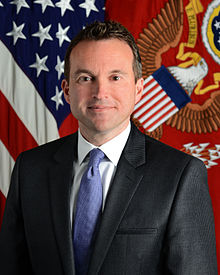
In November 2015, the former President Barack Obama has nominated a new Secretary of Army, and in May, 17 2016 the United States Senate has confirmed nomination. The 22nd Secretary of the Army became Eric Keneth Fanning, who had made a great career as a Congressional staffer, chief management officer for the Department of the Navy, Under secretary of the Air force spending about overall 25 years in government service. However America has a plenty professional military officers, why was this case interesting? The Eric Fanning was the first openly gay in Pentagon . However the situation in last decades was different and gay men and women were not allowed to show their sexual orientation.

The US military policy of 1981 stated ’ “homosexuality is incompatible with military service” is based on the premise that a gay military member’s presence “adversely affects the ability of the Military Services to maintain discipline, good order, and morale.” It was not possible to prohibit the involvement of gay people to the military at all, therefore, in 1994 the President Clinton has adopted the “DADT” policy. “Don’t ask don’t tell policy” stated that homosexual gay and woman are prohibited from serving in US military if they disclose they sexual orientation and only in 2010 the process of ending this “DADT” policy established, therefore from that time homosexual people can serve in military and show their sexuality.

According to study, the 43 % of Americans favored allowing gays to serve in military in 1993/94, however the number has increased dramatically to about 70 %, which means that public became more tolerate.  Also as Davis (chapter 2) showed in his national cross section of US adults (mass) and army officers (brass)   16 % of male officers are opposed to “allowing gays and lesbians openly serving and this lead to author’s “finding 6”.
 
Despite this, according to National Longitudinal study of Adolescent Health (2009) the number of men in military who identified themselves as a gay was approximately the same with those among civilians. This shows that despite the existence of the “DADT” policy the number of homosexuals in military does not decrease, it rather increases and now the representative of gay minority is a head of the largest military service in US. Also what is important Roman and Tarr (chapter 11) argue that when the senior military leaders are selected, the candidates are selected accordingly their “professional background, policy making, experience, personality and political consideration” and what is more important the characteristics that makes a candidate “effective” and here the sexual identity does not matters. Therefore when the question of sexual orientation in military arises, it is more important to look if the person is a professional and does he or she has expertise, responsibility and corporateness.

___________
References:
1. https://informburo.kz/novosti/suhoputnye-voyska-armii-ssha-vpervye-vozglavil-gey.html
2. http://www.rand.org/pubs/periodicals/rand-review/issues/2011/spring/gays.html
3. "H.R.2965 - Dont Ask, Dont Tell Repeal Act of 2010". OpenCongress.org
4. http://biotech.law.lsu.edu/blaw/dodd/corres/html2/d130426x.htm
5. Sexual Orientation and U.S. Military Personnel Policy: An Update of RAND’s 1993 Study, 2010.
6. Sexual Orientation and U.S. Military Personnel Policy: Options and Assessment, RAND Corporation, RAND/MR-323-OSD, 1993, 548 pp., ISBN 0-8330-1441-2.
7. Feaver, Peter, and Richard H. Kohn, ed. 2001. Soldiers and Civilians: The Civil-Military
Gap and American National Security. MIT Press.

8. http://www.military.com/daily-news/2017/01/18/fanning-steps-down-first-openly-gay-service-chief.html

Wednesday, April 19, 2017

LGBT Discrimination in the US Military

By: Daniyar Tengelbay 

Source: http://www.dailykos.com/story/2017/4/8/1651518/-Trump-makes-it-official-Nominates-LGBTQ-hater-Mark-Green-for-Army-secretary-post

American President Donald Trump nominated Mark Green to be an Army secretary. That caused a wave of discontent from LGBT rights protectors as Green is blamed for discrimination of LGBT society. As different states in US have different laws regarding certain issues, in Tennessee Green is opposing LGBT equality and calls the legislation for discrimination of those. Moreover, he replaced Eric Fanning, who was the first openly gay served as Army secretary.
In this occasion, civilians that want to eliminate discrimination oppose the nomination of Green. Which means that those civilians are pro liberal and support those LGBT representatives openly serving. According to Davis (2001), vast majority of male elite officers of US are opposing the gays and lesbians serving openly in military. While the general population is divided in opinions. One could say that attitudes changed and LGBT society is more welcomed to serve. However, there are also supporters of Green, who support discrimination and keep pro conservative views.
One political action committee VoteVets opposed Green, saying that today military is against discriminative leaders and becoming an Army secretary makes him state-sponsored discriminator. Another organization, The American Military Partner Association promoting LGBT in military argue that Army secretary could not be discriminator and LGBT minorities in military need support from him.
Analyzing the recent situation and the development of LGBT issues during the Obama’s presidency it is clear that Obama being a democrat promoted the rights of LGBT minorities. During his rule, there were legalized same-sex marriages and the ban on transgender military service was lifted. However, during the presidency of republicans this is opposite. For example, it is known that George Bush Jr was against same-sex marriages. Thus, there could be an assumption that nomination of Mark Green is the beginning of Trumps politics toward LGBT issues.
As the general attitude towards LGBT is changed in positive way during last decade and the rights of these minorities are promoted more frequently, there could be another assumption that military service is open for LGBT representatives on professional basis. However, there is still open question whether the elite military officers changed their views towards that issue since the research done by Davis even the Pentagon lifted the ban on transgender service in military.

Monday, April 17, 2017

The News Article Summary: "Course towards Professionalization”

Author: Alina Nurtas

Reading            - Nathan W. Toronto, “Why Professionalize? Economic Modernization and Military Professionalism”, 2016.

According to Kazakhstan’s military doctrine which was signed in 2000, state’s military should grow and develop according to the character of the real military threats from the outside or inside of Kazakhstan, with use of the new tendencies or technologies and, what is more important, with state’s economic capabilities. Kazakhstan went through major transformations, and the shift to a market economy is one of them. Market Economy requires the state to redefine its military politics. Issues are yet to be resolved. The situation was complexifyed with Armed Forces’ inability to satisfy the demands of a changing environment, where the geopolitics outside the country changed, and the internal and external politics of Kazakhstan also went through significant alterations. Moreover, Kazakhstan’s army dropped behind neighboring states in terms of the military technologies. Here one would see how Kazakhstani institutions are lagging behind the economic change; according to Huntington (1968) this hinders the military professionalism. Kazakhstan, until recent time, had no effective army financing. The economic questions did not let the state to start military reforms. Importantly, the needs of the army were satisfied by means of the ‘emergency store’. In spite of that, the state identified long term goals – to create centers for mobilized preparation, and invent mobilization reserves. Though, it is hard to modernize the military equipment, professionalize military officers, and educate them, without a proper financing system and well developed economy of the state.
How is it related to our class?
What do we mean by ‘military professionalization”? I believe that a professional military officer should be familiar with military history and the doctrine of his state; he should understand military philosophy and know that violence is the last resort. The later notion was mentioned by numerous authors during the course of the semester. Huntington (1957) once said that military should do nothing but manage violence. This will eventually contribute to the state’s ability to manage military business and violence as well. Enough words were said about the significance and the meaning behind ‘military professionalism’, and people do appreciate that. Though, how to achieve it? As W. Toronto (2016) argued, when the state achieves a higher level of economic stability and modernization, it is likely to professionalize in military terms. Going back to the news regarding Kazakhstan, it comes as no surprise that a young market economy will clash with inability to satisfy its military sector because of unstable economic environment.
What about the direct links between economic modernization and military professionalism? Well, W. Toronto (2016) identifies three main pathways to link the former and the later one. The ‘accumulation of human capital’ or the third pathways seems to fit into Kazakhstan’s frame. From the news article, it became evident that Kazakhstan is about to professionalize its military through creating mobilization reserves and through introducing educational centers for officers. This will empower their multifaceted education and ensure the professionalization. 

Sunday, March 26, 2017

US military uses violent video games in order to train military soldiers.

Author: Zhanara Omarova

After the events of 9/11 violent video games where people are supposed to kill terrorists have became popular types of video games and they are even used in the military training. In order to understand overall opinion regarding these violent video games 15 military soldiers were interviewed. According to these soldiers, video games are very useful in terms of understanding general situation and creation of tactics and strategy. However, there is a question of whether this type of training is really useful. Normal theory of civil military relations is based on Huntington’ solution to civil military problematique how to rise military which provides security and obey civil (Cohen and Owens). According to Huntington this is only possible by objective control where military is professionalized and one of the main purposes of a professional officer is management of violence.  However, in video games there are a lot of violence and if someone dies in video games no one is responsible for that. In video games soldiers do not care if innocent civilians or their peers die. So this type of training according to Romananiuk and Burgers may teach soldiers behave irresponsibly and violently which is not management. Moreover, the author emphasizes that soldiers cannot apply the same tactics that soldiers use in video games in real life because real life is different and in real life soldiers and officers are responsible not for only their own lives but they are responsible for real lives of their peers. There are a lot of video games which do not only simulate real combat but also help to teach how to promote ideas of democracy, pro-Western and pro-democratic societies.  However, the journalist  Shaban  claims  that this is just “brainwashing” and has nothing to do with training (Shaban,2013).

References.

Romaniuk, S. and Burgers, T. (2017). How the U.S. military is using ‘violent, chaotic, beautiful’ video games to train soldiers. [online] Salon. Available at: http://www.salon.com/2017/03/11/how-the-us-military-is-using-violent-chaotic-beautiful-video-games-to-train-soldier/ [Accessed 12 Mar. 2017].
Owens, T. US Civil Military Relations after 9/11
https://drive.google.com/file/d/0B6ZjdzIrVXhQRmk1ekNsU2lqNFk/view


Politicization of Military by Social media and Trump’s politics

Author: Daniyar Tengelbay


According to Huntington (1991), objective control of the military is better than subjective one. He highlights that it includes three main points: expertise, corporateness and responsibility. The aim of the military is to manage violence and serve the general society. And he argues that for achieving these aims professionalism of the military and objective civilian control over it are necessary. Military should be an autonomous institution that does not interfere into the politics, while civilians do not interfere into the military affairs. There should be a proper professional division of duties. One of the significant qualities of the military is political neutrality. People accept them as nonpartisan; and they are the most respectful institution. The author of the article, Bryan Bender (2017), argues that as a military officer person should be fully suspended from politics. While, as a person out of military he has full rights to represent election official, participate in political club, share his views, but not to be a part of political party.
            Bender’s main concern is the role of social media in recent civil-military relations. The rules that separate military from politics are old and social media was not concerned during that time. According to these rules a uniform officer cannot participate in any political actions, but there is nothing about social media in those rules. Meanwhile, sharing and reposting political posts or news can mean active participation in promoting certain political views and ideas. According to the poll, soldiers and officers actively practice such political participation. This leads to loss of the value of military professionalism. Military is high rated institution by public. However, if such “online” political participation will continue, military will lose both its value and public support. The idea of objective control will not matter anymore.  

            Moreover, author says that Trump’s embraces of military and use of retired military generals on his side will also diminish the brand of US military as nonpartisan and professional institution. He provides a link between those two things - the survey and Trump’s election. However, according to “Task and purpose” (2017), a site that analyzes veterans and military affairs, the survey was conducted in 2015, long before Trump’s election. They also argue that “Politico” is ironizing that military was fully out of politics and just started to be involved. It could be said that both are right to some extent. Social media is really a tool that affects people and helps to promote certain ideology or views and it is increasing the political involvement not only of military, but of general public as well. However, as “Task and Purpose” says, military was not fully out of politics as in administration of presidents there have always been retired officers and generals. This does not mean neither that military is politicized, nor that it fully out of politics. It keeps being professional prior of various changes in politics of the state. Therefore, it is wrong to say that Trump is politicizing the military, while the increasing role of social media is clear.

Thursday, January 19, 2017

Trump is against NATO


Zhanara Omarova


New US President Donald Trump expressed his opinion that NATO is becoming useless. He stated that NATO is old because it was created long years ago and the main problem is that it cannot protect the United States from terrorism. He explained it by low funding which other countries should fund in order to support NATO. He also criticizes EU and says that Britain had made a good choice when they decided to leave the EU.  Trump criticized Germany and its leader Angela Merkel for the allowance of free movement of refugees and states that Europe can no longer protect itself from terror. Prussia or modern Germany the first country where military forces appeared as an effective organized structure (Huntington 1957) and now according to  Trump cannot no longer defend itself from terrorism.

I think  Terrorism is  a modern type of war. Different countries handle this problem in different  ways. This type war as other types need troops, funding and structure. As Porter(1994) states war leads to development of logistics, improvement of universal education and healthcare but first of all in order to do that  things we need money and that is why Trump emphasizes that lack of funding in NATO leads to its inefficient  function. Report from defense expenditures of NATO   countries shows that only 5  NATO member states out of 28 states spend enough money and the leading role take up USA which is very unfair according to US president.

I would like to explain this issue by collective action and free riders problem. Huntington states that military is monopolized by the state and if certain state has army this state allocates enough money and this army is governed by certain state. Which makes this army structured. However, NATO does not belong to one special country and here arises the question of free-riding where one state rely on another in terms of funding but all states want to use security that offers NATO. Huntington states that modern military officer should be educated expert with responsibility but in order to train such officer military needs financing which is core problem of NATO today. Last year Obama sent 3500 troops and more than 100 vehicles to Poland as a response to Russian aggression but now  there is a question:  will the new president return these troops back to the US?

__________
Huntington, Samuel P. 1957. The Soldier and the State: The Theory and Politics of Civil-Military Relations. Belknap Press of Harvard University Press, Cambridge MA.

Porter, Bruce D. 1994.War and the Rise of the State 1st ed. Free Press


Wednesday, January 18, 2017

Trump's Untraditional Appointments to Cabinet

Azamat Kabdrash


More generals were nominated to the President’s cabinet since WWII. Sounds intimidating, doesn’t it? At least three military generals are going to be appointed to Trump’s Cabinet. Retired General James Mattis has been nominated as the Defense secretary; retired Marine General John Kelly has been nominated as the Homeland security secretary; and retired Army Lieutenant General Michael Flynn has been appointed as the National security adviser.

Is this situation going to affect civil-military relations in political decision making? Would it undermine peaceful resolutions of military conflicts? To what extent can US politics turn extreme?

Huntington (1957) claimed that Ministers of military affairs do not have to be former soldiers. He argued for what he called “objective civilian control” over military. He stated that military viewpoint in politics can undermine efficiency of decision-making. Favoring the neutrality of military in state politics keeps military as a state tool, which, in turn, should be controlled by civilian ministers (58).

It seems that Donald Trump has a different opinion. His appointment of General Mattis as the Defense secretary is the most noticeable among others. Constitutionally it is prohibited to take the position of Defense secretary for military officers. At least 7 years should pass since an officer retired from military service. As Mattis retired in 2013, he will need a special waiver approved by Congress (which seems to be almost done) to allow to take that position.

Are these appointments really justified so that Congress should process a special waiver for Mattis? I present two facts that would support that they are justified.

Firstly, military members (especially generals) tend to have very conservative overviews. They are well adapted to live by rules and orders. Liberal values such as individualism and self-determination are very uncommon among them. Building a presidential cabinet, own circle, a team needs reliable people whom you can trust and consult with. In this regard, competent and, what is more important, “obedient” generals is a good choice for Trump to appoint them as secretaries.

Secondly, the whole beauty of the US Government is laid upon the check and balance system. What does it mean? Constitutionally the three branches – legislative, executive and judiciary – function with no prevailing authority over one another. It means that no decision is made, no bill is passed, no law is issued without the approval of all the three branches. Therefore, even if the Cabinet secretaries (representing an executive branch) might have utterly different standpoints on the US politics, it wouldn’t have extreme changes as long as there are two other branches left.

The three mentioned above appointed secretaries are highly expert former military professionals.  Time will show us how they will perform their duties in civilian service. I hope that their unique military backgrounds would demonstrate how effective can civil-military relations be.

___________________                                                      
Drezner, D. W. 2016. My concern with Trump’s team of generals. Retrieved January 17, 2017, from https://www.washingtonpost.com/posteverything/wp/2016/12/05/my-concern-with-trumps-team-of-generals/?utm_term=.05bc3932ee33

Huntington, Samuel P. 1957. The Soldier and the State: The Theory and Politics of Civil-Military Relations. Belknap Press of Harvard University Press, Cambridge MA.

Wright, A., & Herb, J. 2017. Democrats’ role for Mattis: The anti-Trump. Retrieved January 17, 2017, from http://www.politico.com/story/2017/01/james-mattis-confirmation-hearing-takeaways-233550